
KEY TAKEAWAYS
▸ Regardless of the mattress size or types of mattresses (a memory foam mattress or a traditional spring mattress), correct mattress storage means maintaining the shape of the mattress and preventing mold and mildew growth.
▸ Do not lay your mattress on its side. The key to keeping your mattress in top shape is to mimic the natural position of a bed by laying the mattress flat inside your self storage unit with no items resting on top.
▸ When storing, remove any bedding first. Wrap the mattress securely in a breathable plastic cover and secure the cover with rope or tape.
▸ While in storage, keep the mattress at a reasonable temperature – humidity and mold are the greatest threats to the life of your mattress, so you might opt for a climate-controlled storage unit.
Storing a mattress usually means there’s something big going down.
Maybe you’re downsizing your living space. Maybe you’re in between places, or navigating a home renovation.
Or maybe I’m wrong, and you’re simply rotating a guest bed out of use.
Regardless of the reason, knowing how to store a mattress correctly can mean the difference between sleeping comfortably on it years from now or tossing and turning and tossing it to the curb.
A mattress is no small investment, and improper storage is one of the most common ways to waste it. You’ve got to plan for extreme temperatures, shifting humidity levels, and potential pests.
But proper mattress storage isn’t complicated once you know the steps. The same core principles apply across all types of mattresses, from memory foam mattresses to spring-style mattresses to latex mattresses and hybrids. Keep it flat, keep it clean, keep it covered, and control the environment around it.
This helpful guide explains how to store a mattress for a long period of time while keeping it in ideal condition. We’ll also reveal how to use SpareFoot to find a how to find a viable mattress storage option that offers the first month free.
But first, let’s take a look at what features the perfect mattress storage location needs to have.
Why Climate-Controlled Storage Matters for Mattress Storage
Extreme temperatures can cause your brand-new mattress to shrink and expand, resulting in fabric deterioration and discoloration.
If the humidity levels in your storage unit are too high, the moisture buildup can cause mold and mildew growth. But if the humidity is too low, the dryness can cause your mattress to warp and crack.
Storage units with climate control maintain consistent temperatures between 55-80°F year-round. They also run humidity regulation equipment to keep humidity levels in the ideal range. In short, climate-controlled storage keeps your mattress safe from the humidity swings, moisture buildup, and environmental hazards.
Let’s zoom in a little and take a look at how climate-controlled storage keeps your mattress safe for the duration of its time in storage.
- Environmental Protection: We already covered the obvious weather-oriented perks of climate control–extreme temperature and humidity control. But there are other environmental factors that climate control helps manage. First off, climate control units are typically organized inside an indoor building. The extra layers of walls, doors, and weather sealing keep snow, rain, and wind from entering your unit through the cracks on the door, and when you’re opening and closing it. These indoor climate-controlled facilities also act as pest deterrents, helping to keep bugs and rodents from building nests inside your mattress.
- Maintains Healthy Air Quality: The sealed, indoor climate control building with constant air circulation also helps to filter dust, pollen, fungal spores, and debris long before it can get inside your unit and coat your mattress with a layer of dirt and contaminants.
- Increased Security Measures: The indoor facilities’ climate-controlled units are locked inside, which also adds an extra layer of security. Not only do you have to pass through the coded front gate of the storage unit, but there’s also a separate code for the building your unit is located inside. The halls of the buildings are typically monitored by security cameras, and then, of course, there are the locks you secure your unit door with. That’s in addition to the motion sensors and security cameras in the parking lot.
- Keeps it Comfy: In the blistering cold, scorching heat, or thundering rain, sleet, or snow, loading and unloading your mattress in and out of climate-controlled units during extreme temperatures is a lot more comfortable than a standard outdoor unit. The heated and air-conditioned indoor hallways make it easier, more comfortable, and safer to pull things in and out of the unit while you’re organizing and maintaining your unit layout.
How To Store a Mattress:
Now you understand how to find the ideal location for mattress storage. Let’s get into the step-by-step process of how to store your mattress, starting with how to prepare your mattress for storage.
1. Measure Your Mattress for Storage
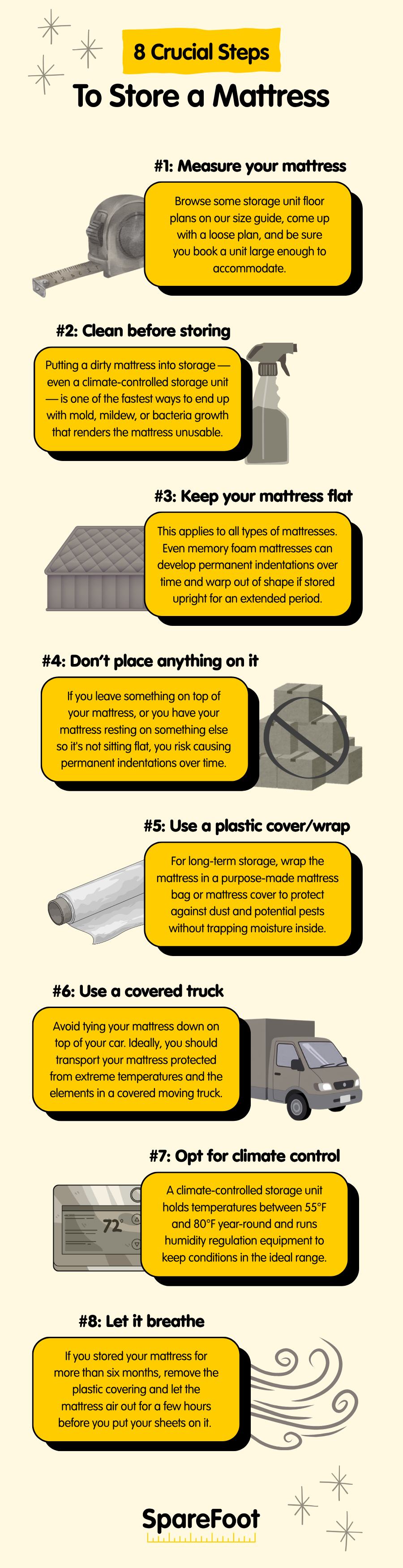
Before you physically prep your mattress for storage, we suggest you measure your mattress. Browse some storage unit floor plans on our size guide, come up with a loose plan, and be sure you book a unit large enough to accommodate.
You may want to start planning out a layout at this stage as well, starting by measuring the unit itself. Keep in mind that we’ll be disassembling your furniture before storing it to save some space:
- Make a diagram of your storage unit organization strategy.
- If you’ll need to access your mattress frequently, put it closer to the front of the unit.
- If you won’t need to access your mattress on the regular, put it against the back wall so you’re not disturbing its flat resting position by constantly pulling it in and out.
2. Clean Your Mattress Before Storing It
This step gets skipped more than it should, and it’s one of the most important. Putting a dirty mattress into storage — even a climate-controlled storage unit — is one of the fastest ways to end up with mold, mildew, or bacteria growth that renders the mattress unusable.
Strip all bedding, throw an upholstery attachment on your vacuum, and vacuum the entire surface to pull out dust, dead skin cells, and debris from the fabric. Pay extra attention to seams and crevices.
For stains, avoid harsh cleansers or bleach-based upholstery cleaners — these can break down foam and fabric.
Dab your spots out with a mild soap and water solution. Hit the tough stains with a non-toxic stain stick or a non-corrosive stain remover, both of which you can find at hardware stores or online retailers.
Work the stain remover in gently with a clean cloth, then let the spots air dry completely before moving on.
Keep Your Mattress Flat.
This is the main reason this guide exists. Not to point fingers, but other blog posts and websites often say to store the mattress on its side — and that’s bad advice.
If you stand it up, the padding and coils can settle, and the mattress will never be the same. Don’t forget, gravity’s not always our friend.Frank Massaro | Co-owner, Mattrezzz Guys, Austin, TX

This applies to all types of mattresses. Even memory foam mattresses can develop permanent indentations over time and warp out of shape if stored upright for an extended period.
To mimic the mattress’s natural position, lay it flat on a level surface — ideally, setting up your bed frame or platform bed inside your storage space and resting the mattress on top. Another option is to build a loft or perch using your moving boxes and placing your mattress flat on top.
Don’t lay your mattress directly on the ground. It wastes space and leaves it vulnerable to moisture damage in the event of any water on the floor.
3. Don’t Place Anything On Your Mattress.
Gravity works against you here. If you leave something on top of your mattress, or you have your mattress resting on something else so it’s not sitting flat, you risk causing permanent indentations over time.
To avoid wear and tear, make sure nothing is weighing down your bed. The only thing that should be on the mattress and box spring is a plastic cover.
4. Use a Plastic Mattress Cover or Plastic Wrap.
This final layer of protection can prevent worst-case scenarios. For long-term storage, wrap the mattress in a purpose-made mattress bag or mattress cover. These are made from breathable material. The fact that they’re designed specifically for mattress storage makes them a helpful option.
A mattress bag protects against dust and potential pests without trapping moisture inside.
Sheets of plastic or stretch plastic wrap secured with duct tape are ok to use for protection during transport or short-term storage. But don’t seal a mattress in non-breathable plastic for long-term storage. Plastic can trap moisture inside, creating exactly the conditions mold and mildew need to grow. I
If your mattress bag has a built-in sealing system, use it. If you’re using a washable cover instead, make sure it fits snugly and seal any gaps with duct tape.
The primary purpose of wrapping your mattress is to prevent dust from settling into the fibers of your mattress, which can happen even inside the cleanest indoor storage unit.
A proper cover also helps protect against potential pests and moisture. You should apply the cover before moving to help protect it during transport. Make sure you cover the entire mattress and secure the cover with tape without taping directly onto the mattress.
5. Use a Covered Truck.
While we’re on the topic of transportation, you should avoid tying your mattress down on top of your car. You’re either going to warp your mattress by tying it down too tightly or ruin it by having it fly off the top of your car and onto the road.
You also want to avoid smushing it to fit in a truck bed, as you could damage the mattress’s shape and structure, even during a short drive.
Ideally, you should transport your mattress protected from extreme temperatures and the elements in a covered moving truck.
It’s okay to transport the mattress on its side as long as you aren’t leaving it there long-term, according to Peter Cancelli of The Mattress Expert.
6. Get a Climate-Controlled Storage Unit.
We covered choosing the right mattress storage location up front, but let’s reiterate. After all, it’s not just our opinion — it’s the experts’ as well.
“If you’re storing for an extended length of time, use climate-controlled storage,” Massaro advises.
This applies anywhere with a humidity level that swings above 50 percent, which applies almost everywhere at some point in the year.
Extreme temperatures cause mattress materials to expand and contract, leading to fabric deterioration and discoloration. High humidity creates moisture buildup that leads to mold and mildew; low humidity can cause materials to dry out and warp.
A climate-controlled storage unit makes the best potential mattress storage space option because it holds temperatures between 55°F and 80°F year-round and runs humidity regulation equipment to keep conditions in the ideal range.
Even if you’re storing the mattress at your house, you’ll want a low-cost, battery-operated thermostat to help you monitor the conditions. But it won’t regulate them the way a climate-controlled storage unit does.
Mold and mildew are a serious threat to the health of your mattress and potentially to your health.
6. Let it Breathe.
Don’t let your mattress stay sealed and in storage for more than six months maximum before airing it out and inspecting it.
If you stored your mattress for more than six months, remove the plastic covering and let the mattress air out for a few hours before you put your sheets on it. This allows any lingering odor from the storage environment to dissipate.
How To Prep a Mattress for Storage Using SpareFoot
By now, you should have a pretty solid idea of how to store a mattress for storage and how to pack your mattress for climate-controlled storage specifically.
But preparing your mattress for storage is only half the battle. You’ve got to move it without damaging it. And where you store your furniture is vital to maintaining its condition.
We’ve also covered the importance of climate-controlled storage and how moisture, pests, and temperature fluctuations are your primary enemies when putting mattresses in storage. But what about 24-hour access and security cameras?
But as we mentioned, storage units come in different sizes. Book one too large, and you’re paying for space you don’t need. But if you go too small, you may need to book a second, smaller unit and pay more per square foot than if you booked a single large unit with the same amount of floor space.
So how do you find the right size unit that has exactly the amenities you need in a convenient location near you?
That’s where we come in.

SpareFoot lets you browse and compare self-storage units using special amenity filters that isolate the storage facilities in your area with all the ideal storage features your storage unit needs.
Just punch your zip code into our signature SpareFoot Storage Search Tool, and you’ll see what we mean. In fact, we also have a SpareFoot storage unit deals locator tool you can punch your zip code into to find facilities in your neck of the woods that offer the first month of storage for free!
Never store a mattress on its side. Standing a mattress upright allows the internal padding and coils to shift and settle under gravity, causing permanent damage that can’t be reversed. This is true for all types of mattresses, including memory foam, which can warp and develop indentations over time when stored vertically. Short-term transport on its side is fine, but once it’s in the unit, it goes flat.
The best way to store a mattress is flat on a level surface, elevated off the floor, with nothing resting on top of it. Clean and fully dry the mattress before storage, wrap it in a mattress bag or mattress cover secured with duct tape, and store it in a climate-controlled storage unit to protect against humidity, extreme temperatures, and potential pests. Never place it directly on the ground or stack items on top.
Always store a mattress flat. Storing a mattress upright or on its side for any extended period puts stress on its internal structure that it was never designed to handle. Innerspring coils can shift and settle permanently. Memory foam can warp and develop indentations over time. The result is lumps, sagging, and uneven support, and none of that damage is reversible.
To store a mattress when not in use, clean it thoroughly, let it dry completely, then wrap it in a mattress bag or sheets of plastic secured with duct tape. Store it flat on a level surface like a bed frame, platform bed, or raised platform inside a climate-controlled storage unit. Don’t stack anything on top. Aim for six months maximum before airing it out and let it breathe for a few hours before use by removing the cover and, if needed, applying baking soda to neutralize any odor.
A mattress can get moldy in a storage unit if the mattress goes in dirty or the humidity level in the unit isn’t regulated. Moisture trapped in foam or fabric creates the exact conditions mold and mildew need to grow. A climate-controlled storage unit that maintains stable humidity levels is the most effective way to prevent this. Always clean and fully dry your mattress before storage, and never skip the protective mattress bag.
Remove the plastic cover and let the mattress air out for several hours. Vacuum both sides thoroughly using an upholstery attachment. For odor, sprinkle baking soda over the surface, let it sit for an hour, then vacuum it up. For stains, apply a mild soap and water solution, a stain stick, or a non-corrosive stain remover. Avoid harsh cleansers and bleach-based upholstery cleaners, which can damage the materials. Let all spots air dry completely before using the mattress.
Store a memory foam mattress the same way as any other types of mattresses, flat on a level surface, wrapped in a mattress bag, inside a climate-controlled storage unit. Memory foam is especially sensitive to extreme temperatures and excess moisture, both of which can warp the foam structure. It’s also prone to developing permanent indentations over time if heavy items are placed on top, so keep the surface completely clear throughout storage.
Stacking mattresses flat on top of each other is acceptable when space is limited. Make sure the floor beneath is clean and dry, and elevate the stack on a bed frame or platform bed if possible to protect against floor moisture. Avoid stacking more than two or three mattresses, as sustained weight can compress the lower mattresses and cause indentations over time.

Tony Emerson
Tony writes columns about the best way to store commonly-stored items. He also writes about marketing, technology, and other fun stuff like zombies and IKEA furniture.