
KEY TAKEAWAYS
▸ Whether storing or driving, proper tire pressure, tread depth, and switching to winter tires in harsh climates ensure optimal traction on icy roads.
▸ Maintaining proper antifreeze ratios, using winter-grade oil, switching to de-icing washer fluid, and keeping fuel tanks above half-full protects against freezing, corrosion, and engine damage.
▸ Cold temperatures significantly reduce battery capacity, so testing batteries over 3 years old, cleaning terminals, and keeping connections corrosion-free help prevent winter breakdowns.
Preparing your car for winter is essential for several reasons.
For starters, if you’re storing your car for the season, you’ll need to winterize your vehicle for storage using our basic winter checklist, so you don’t return to clogged fuel lines and a dead battery.
If you plan to drive all winter and live in a moderately cold or seasonal climate, you’ll want to run down a basic car maintenance checklist and make sure everything is fresh and topped off. The cold wears your fluids, tires, and battery faster.
If you live somewhere with harsh winter temperatures and hazardous winter weather, you need to prep your car for driving on icy road conditions and holding up against moisture and road salt.
But SpareFoot is here to help you and your vehicle get winter-ready and stay safe from the winter weather.
Our helpful guide details the steps you should take to winterize your car for storage and to prepare your daily drivers for winter driving.We’ll also explain how where you store your car is as critical to its longevity as the maintenance is. We’ll reveal how SpareFoot can help you find the ideal place to store your car for winter.
Winter Car Care Tips: Winterizing Your Car For Storage
Winterizing any vehicle before you store it for a full season can be an intimidating task, whether it’s a boat, ATV, car, or truck. It can be equally overwhelming for seasoned drivers and new car owners.
It’s easy to lose track of what needs to be done. So here’s a quick, straightforward checklist of steps for winterizing a car for storage:
Winterize Your Car Checklist
- Coolant System: Maintain a 50/50-70/30 ratio of antifreeze to water; 50/50 in moderate winters in seasonal climates and 70/30 in extreme cold.
- Exterior and Interior Cleaning: Clean the entire vehicle, inside and out, including the tires and rims, and all the small storage spaces inside.
- Engine and Fuel System: Add a fuel stabilizer to your fuel tank and run the engine to distribute it to the fuel lines.
- Tires and Brakes: Inflate tires to the correct PSI level and check the brakes–check the tire pressure throughout the season.
- Battery: Disconnect the battery negative first and clean the terminals. Then, reconnect the terminals, positive first, and keep it on a trickle charger or smart battery maintainer so it’s fully charged and ready to go at all times.
- Store It Out of the Harsh Weather: If you don’t have a garage, find a car storage space that keeps your car safe from the snow, ice, UV rays, and temperature fluctuations. We suggest a car storage unit. But at the very least, cover your vehicle with a hefty weather-resistant car tarp, even if it’s under a carport.
Remember, these are just the basic steps. Always consult your vehicle’s owner manual for specific winterization instructions related to your model, especially if you’re storing a car long-term.
And if you’re storing a collectible car, find an old manual or mechanics thread online that explains how to winterize that specific make and year model.
Winterization is an integral part of car ownership, so take your time and do it right.
Now, if you plan to drive your car all winter, there are some nuanced differences to the preparation steps.
That said, you’ll notice some crossover between winterization for storage and prep for winter driving. We suggest reading on even if you’re storing your car, as some of these sections include tips for winterizing your vehicle as well.
Winter Car Care Tips: How To Prepare Your Car For Winter Driving
1. Tire Maintenance
If you plan to drive in the snow, you’ll want a vehicle with a four-wheel drive system, preferably with traction control. But even the most high-tech traction control system can’t make up for deflated, worn, or incorrect types of tires.
Swap Your Tires Out
If you plan on driving your car but live in a seasonal or moderate winter climate, all-season tires can provide safe driving year-round. As the name implies, all-season tires perform fairly well in all four seasons but aren’t specialized for any one climate.
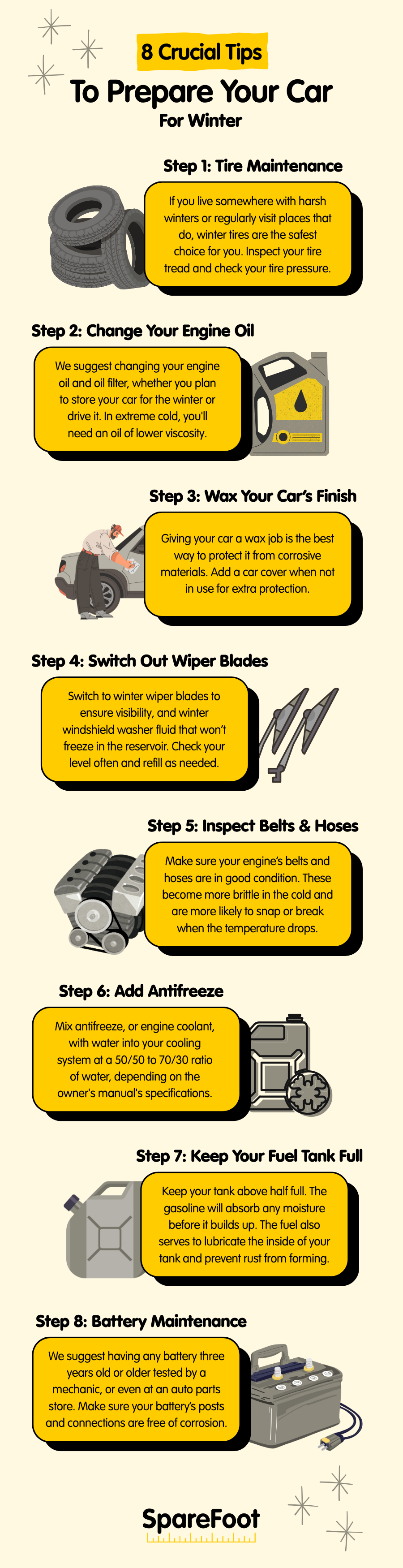
That said, if you live somewhere with harsh winters or regularly visit places that do, winter tires are the safest choice for you.
That said, if you live in a region of harsh winter temperatures and hazardous road conditions, we suggest installing winter tires/snow tires when preparing for winter driving. All-season tires can handle the cold and slushy roads, especially if they’re plowed regularly. But snow tires are equipped for snow-covered, icy roads.
And that’s not to mention the freezing temperatures.
- Seasonal climates get cold in the winter and experience freezing temperatures, but it’s not below freezing 24 hours a day.
- In harsh winter climates, the temperature is consistently freezing or below freezing.
- This causes the rubber compounds in non-winter tires to get hard and brittle, which reduces their traction capabilities.
Tire manufacturers design winter tires from materials that don’t harden in freezing and below-freezing temperatures, so they maintain their grip on the road whether the roads are dry or covered in slush, snow, or ice. Traction in ice, snow, slush, and even dry pavement.
Inspect Your Tire Tread
Whether snow tires or all-season tires are the appropriate choice for your climate, you also need to check their level of wear. Use a tire tread depth gauge to measure the tire treads, specifically in the middle of the tire and on each edge. If your tread is worn, your handling and traction control won’t be able to handle wet or icy roads the way the tire is engineered to.
Check Your Tire Pressure
Make sure you have adequate tread on your tires and check that the air pressure inside your tires is at the correct level.
And remember, you lose 1 PSI for every 10 degrees the temperature drops. And you gain it back as the temperature warms 10 degrees in the opposite direction.
We suggest measuring your tire pressure often during winter, especially if the temperature fluctuates. Refill or deflate your tire pressure as needed, following the specification in your car’s make and year model owner’s manual, or on the spec card on the driver’s side door jamb.
2. Change Your Engine Oil
Cold temperatures cause oil to thicken, which can prevent it from lubricating your engine, causing damage. Engine oil that’s already worn will wear even faster in the cold.
We suggest changing your engine oil and oil filter, whether you plan to store your car for the winter or drive it. In extreme cold, you’ll need an oil of lower viscosity. The number before the W represents viscosity, so 5W-30 has a lower viscosity than 10W-40.
Check your owner’s manual for the right type. So if you haven’t gotten an oil change recently, be sure to take care of that before the dead of winter.
3. Wax Your Car’s Finish
Winter roads are filled with moisture and road salt–a corrosive combination that will eat away at your paint. And since paint protects your car’s body, once the paint is stripped off, the exposed aluminum underneath the paint is vulnerable to damage.
Giving your car a wax job is the best way to protect it from corrosive materials. Add a car cover when not in use for extra protection.
4. Switch Out Wiper Blades
Regular wiper blades struggle with snow and ice. Switch to winter wiper blades to ensure visibility. Windshield wiper fluid can freeze and will be unable to spray. Switch to winter windshield washer fluid that won’t freeze in the reservoir.
If you’re not sure if you’re washer fluid is a de-icing fluid, add some anti-freeze to your fluid reservoir, after consulting your owner’s manual, of course.
Or, you can ask your local auto parts store what de-icing windshield washer fluids are available, and in many cases, they will install the fluids for you for no extra charge.
Keep in mind that you’re using more wiper fluid when you’re spraying it to de-ice your windshield during a snowstorm or heavy sleet, etc.
Get some extra gallons of fluid, check your level often, and refill as needed, especially after heavy usage driving during a big snow.
5. Inspect Belts & Hoses
It never hurts to take your car in for a tune-up, particularly just before the hard winter months.
Make sure your engine’s belts and hoses are in good condition. These become more brittle in the cold and are more likely to snap or break when the temperature drops.
6. Add Antifreeze
Mix antifreeze, or engine coolant, with water into your cooling system at a 50/50 to 70/30 ratio of water, depending on the owner’s manual’s specifications.
Antifreeze regulates your engine as the temperature outside changes from extremely hot to extremely cold. Proper levels of antifreeze will help prevent engine corrosion and seizing from mice and moisture content, or overworking.
We suggest checking your antifreeze/coolant levels twice a year.
7. Keep Your Fuel Tank Full
During the winter, moisture can build up in your gas tank and corrode the metal inside. If this moisture freezes or if the corrosion flakes off into your fuel lines, you could experience heavy damage in your fuel system.
Prevent this by always keeping your tank above half full. The gasoline will absorb any moisture before it builds up. The fuel also serves to lubricate the inside of your tank and prevent rust from forming.
And last but not least, keeping the fuel levels topped off stops the fuel lines themselves from freezing.
8. Battery Maintenance
Harsh winter weather can dish out a pounding to your car battery, especially if the car isn’t being used at least a few times a week.
For starters, your battery capacity actually decreases as the cold shrinks your charge. If your battery is already old, its capacity may already be reduced just from wear and tear.
You want to make sure you’re starting the season with a full battery that’s not already worn down. We suggest having any battery three years old or older tested by a mechanic, or even at an auto parts store, and they can tell you if it’s
Next, be sure your battery’s posts and connections are free of corrosion:
- Disconnect the negative, then the positive cable.
- Clean with a battery tool or wire brush, and wipe the top with a paper towel.
- Reconnect the positive, then the negative cable.
Things To Pack in Your Car During the Winter
- Gloves will make using everything else that much easier. There is a reason your car has a glove box after all!
- An ice scraper can help to easily scrape the ice off your windshield rather than waiting for it to thaw.
- Small shovel will help you clear paths and remove snow that can accumulate on your vehicle.
- Tire chains are used to gain traction on those icy roads; these are only a must if you frequently drive on unplowed roads.
- Kitty litter, road salt, or sand are all deicers that will help thaw the snow on the road and provide traction if you get stuck.
- Jumper Cables in case of cold-weather battery failure. Some people even keep extra batteries in their car, as winter weather can sap the juice from one that is near the end of its life. But keep in mind that the new battery will lose its charge if it’s sitting in the freezing cold trunk all winter without a recharge.
- Spare car charger for your phone or tablet in your car to ensure your phone is alive and handy at all times, just in case you have winter weather car trouble.
- Emergency or first aid kit, including a safety vest, flares, flashlight, first aid supplies, and anything else you need in case you find yourself stuck on the side of the road.
Preparing Your Car for Winter Storage? SpareFoot Can Help
Now that you understand how to prepare your car for winter driving or winterize it for storage, let’s take a look at the ideal storage location. We suggest storing your car indoors in a climate-controlled storage space, and we’ll explain why.
For starters, let’s consider the ideal car storage options. Then, we’ll talk about how SpareFoot can help you find car storage.
- When storing a car at a storage facility, consider location, security, ease of access, the size of your vehicle versus the size of the parking space, and whether you need covered or indoor storage.
- You’ll also want to consider how long you’ll be storing your vehicle and the amount of protection you need.
- Outdoor storage facilities, whether covered with a canopy or uncovered, are available for a lower price. But these more affordable options are typically intended for short-term vehicle storage.
- Indoor is the better move for long-term storage as it helps to prevent prolonged exposure to the harsh winter temperatures, ice, snow, and sleet that grind your vehicle’s condition down fast.
That’s where we come in. Whether you’re looking for an indoor or outdoor storage space, our handy car storage search feature can help you find a perfectly sized car storage facility.
More than a few of the car storage facilities in our listings offer the first month free, so you may even avoid paying anything at all.
Just enter your zip code into SpareFoot’s site to find the best deal on a dedicated vehicle storage space near you. SpareFoot gives you access to the largest marketplace for storage facilities of all types, and our storage search tool makes finding storage units ideal for long-term car storage as easy as entering your zip code, filtering the options, and scrolling the results until you find exactly what you need.
Check and adjust tire pressure, swap to winter tires if needed, change engine oil to lower viscosity, add antifreeze at proper ratios, and switch to winter wiper blades and de-icing washer fluid. Wax your car’s finish, inspect belts and hoses, test your battery, and keep your fuel tank above half-full to prevent moisture buildup and corrosion.
The 5 P’s of winter weather preparedness are People, Pets, Pipes, Plants, and Prevention. People should dress in layers and appropriate outdoor clothing while pets need indoor shelter. Pipes require insulation and dripping faucets during freezes. Plants should be covered or brought inside, while preventing fires and air quality issues requires installing carbon monoxide detectors and maintaining safe heating and fireplace practices.
People put a glass of salt in their car to help absorb excess moisture from the air while the heat is blasting with the windows up. Salt is hygroscopic, meaning it attracts and holds water molecules. A cup of salt reduces the humidity inside the vehicle, preventing foggy windows, eliminating musty odors, and stopping mold or mildew growth. This maintains a drier, fresher interior environment.
The 30-60-90 rule recommends maintenance at 30,000-mile intervals. At 30,000 miles, replace the air filters and rotate tires. At 60,000 miles, change your transmission fluid and inspect your brakes. At 90,000 miles, replace the timing belt and service the suspension system. Following this schedule prevents major breakdowns and extends your vehicle’s lifespan.

Brian Shreckengast
Brian Shreckengast is a writer at SpareFoot